Do Not Originate List vs Spam Feed: What Each Blocks

By Dmitry B. 4 min read
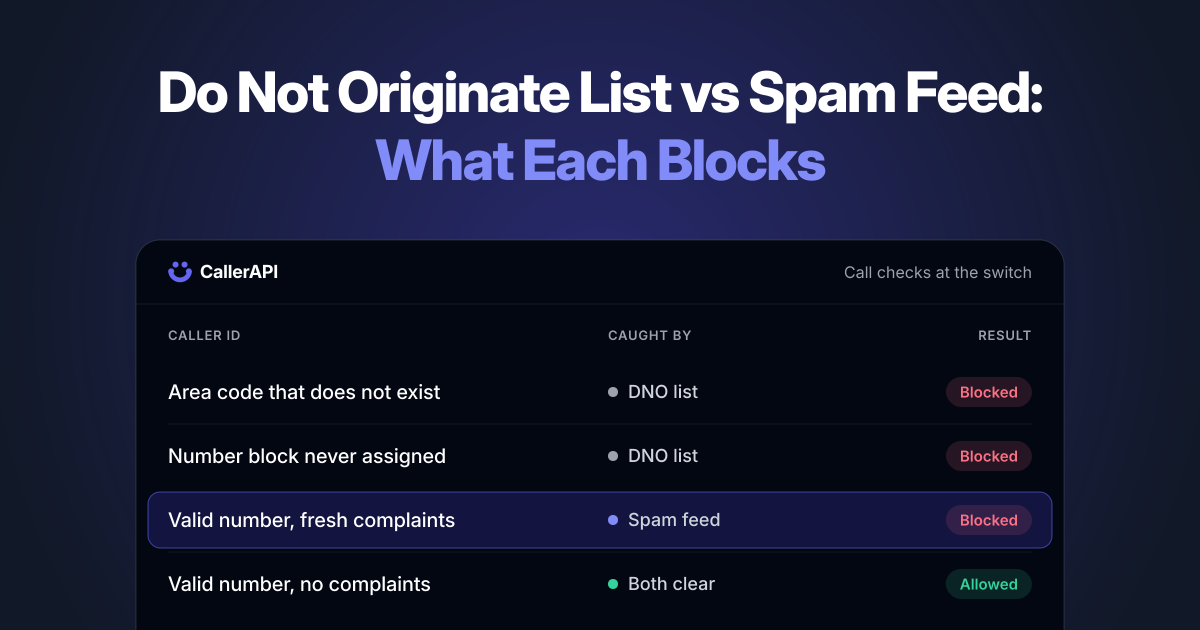
Do not originate list blocking became mandatory for every US voice provider in the call path on December 15, 2025. Before that date, the rule bound only gateway providers. A DNO list stops calls from numbers that should never place a call. It does not stop calls from numbers that are valid, assigned, and running a campaign today. This post shows what each list covers, and why a network runs both.
What the rule requires
The FCC adopted the rule in its Eighth Report and Order on robocalls (FCC 25-15) on February 27, 2025. It sits in 47 CFR 64.1200(o). A public notice (DA 25-909) set the effective date for all providers to December 15, 2025.
Three points matter for an operator:
- Every US provider in the call path must block calls that claim to come from a number on a reasonable DNO list.
- The FCC does not name one list. Any list that is reasonable is allowed.
- The list must apply to all calls that transit the network.
What a reasonable list may hold
The rule is narrow on purpose. A reasonable list may include only four kinds of numbers:
| Category | Example |
|---|---|
| Invalid | A number in an area code that does not exist |
| Unallocated | A number block not assigned to any provider |
| Unused | A number the provider holds but has not assigned to a subscriber |
| Inbound only, on request | A bank’s customer service line whose owner asked for outbound blocking |
The FCC also warns that a list “so limited in scope that it leaves out obvious numbers that could be included with little effort” may be judged unreasonable. A list that is too thin can fail the test.
What it cannot hold
A number that is valid, assigned, and in use cannot go on the list. That stays true even if consumers report it every hour. Scam and robocall campaigns lean on exactly these numbers: rented DIDs, recycled numbers, and numbers that pass every validity check.
Look at the numbers people actually report and most of them are valid, assigned numbers. A DNO list cannot hold any of them. Many also sit outside the US, where the FCC rule does not reach.
A complaint does not prove who placed the call. Caller ID spoofing is common. That is why the complaint subject and date matter as much as the number.
Side by side
| DNO list | Spam number feed | |
|---|---|---|
| What is on it | Invalid, unallocated, unused, and inbound-only numbers | Valid numbers under consumer complaint |
| Legal basis | Required for US providers since December 15, 2025 | Allowed as analytics-based blocking, with notice and redress |
| How it changes | When numbers are assigned or requested | Every minute, as reports arrive |
| Coverage | National rules, country by country | 195 countries |
| False blocks | Low by design | Set by your own rules: block, label, or send to review |
How a network runs both
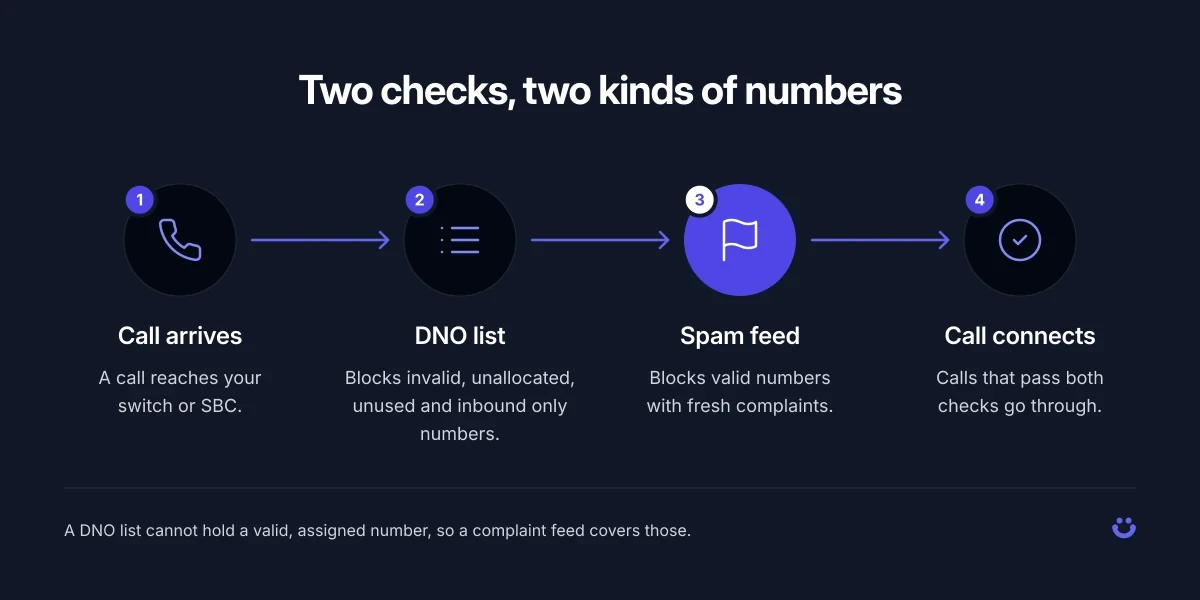
- Load the DNO list at the switch or SBC. Block any call that presents a listed number as caller ID.
- Load a complaint-backed feed next to it. Block or label numbers with fresh reports.
- Store the reason for every block: which list matched and, from the daily reports endpoint, the complaint subject and date.
- Tell the caller. The same FCC order makes SIP 603+ the code for calls blocked on analytics on IP networks.
Where CallerAPI fits
The CallerAPI spam phone number database is the second list. It holds every number reported in the last 15 days, across 195 countries, in one file you host, refreshed every minute. There are no per-lookup fees. It does not replace your DNO list. It covers the numbers a DNO list is not allowed to hold.
If you would rather decide on each call as it arrives, the robocall scoring API returns a block or allow answer per number.
Running Falcon? Add a CallerAPI key and turn on the spam feed, and our open-source robocall mitigation software (setup guide) downloads the list on a timer and rejects calls from listed numbers.
Get the spam number feed
Every number reported in the last 15 days, across 195 countries, in one file you host.
See the spam number feed
Look up a number
Open the public record for any number. See the complaint count and the subject.
Look up a number